Two Company Veterans with a Passion for Cheese
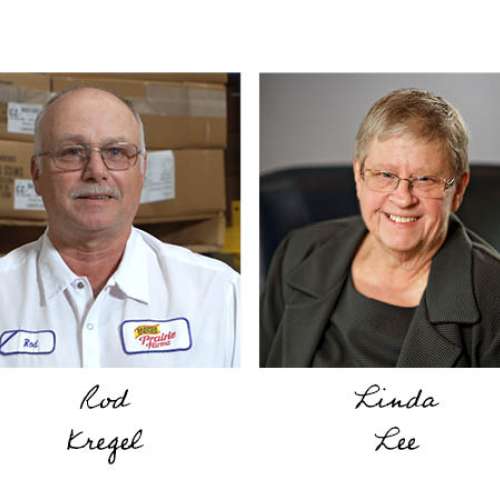
With a combined 92.5 years on the job, two veterans of the Prairie Farms Dairy Cheese Division share with us their career history, what’s changed in the industry and what they’ve learned along the way.
Rod Kregel celebrated Christmas Eve a little differently in 1978.As a recent high school graduate uncertain of the next step in life, Rod was given a job offer at the Luana plant with one caveat – he had to report for duty on Christmas Eve.“I didn’t even fill out an application,” remembers Rod.“I had no idea what was inside the plant – they just gave me a pair of boots and I got started.”
43 years later, Rod has a pretty good idea of what’s inside the plant, which is the largest of Prairie Farms Dairy’s cheesemaking facilities.Rod is a Cheese Technologist for the Prairie Farms Cheese Division, where he oversees the production of Swiss, Baby Swiss, Gouda, Maasdam and Havarti at the facility.For a large chunk of his career, Rod was the Swiss Department Manager, and has also held the position of Plant Manager as well as a role in R&D.As Swiss Department Manager, Rod enjoyed having a seat at the table for all of the decision making, and working closely with the graders to pass down his wealth of knowledge when it comes to cheese grading.“Of all the cheeses, Swiss is out there on an island by itself,” says Rod.“It’s good to know what cheese should be.”
The aroma, flavor and eye formation that makes for a good Swiss cheese haven’t changed, but the industry, the technology and the on-farm practices certainly have during Rod’s career.Rod recalls that milk used to come to Luana in 10 gallon cans.He remembers the strong push in the 80s for milk to be pasteurized, and teaching his graders to be on high alert for the taste of onion, caused by the curious cow wandering off the pasture to snack on wild onions.He smiles thinking of the days when he and a fellow co-worker would hoist a 200-pound block of Swiss into the brine tank, one of many of the steps done manually.Today, milk arrives in 5000-gallon tanks, and the plant must pasteurize every last drop.There are certainly less curious onion-eating cows, and almost every step of the Swiss-making process is automated.Milk quality has been greatly improved with the implementation of pH meters and bacterial and antibiotic testing.
That quality milk results in quality cheese, which Rod says is the most rewarding part of the job.“I love seeing the quality of product at the grade line.Our products are at the top of the category in almost every contest we enter,” he says.Of the many awards accumulated by the Luana plant, two of Rod’s favorites are when Swiss took home top honors at the World Championship Cheese Contests in 1993 and 2008.
Reflecting back, Rod is thankful that instead of pursuing a career in mechanics, he decided instead to put on those boots the day before Christmas over four decades ago.In a way, mechanics and cheesemaking aren’t that different according to Rod. “You have to be able to troubleshoot – here is the problem and how are we going to correct this problem?” he says.“I guess I like the challenge.”Along with the challenge, there’s also a little bit of magic to the process.Rod quips, “You take a gallon of milk and add some lactic acid cultures, and now instead of 20 days it’s good for a year!”
Like Rod, Linda Lee has seen a lot through the years during her 49.5-year career history with the company.And it all started when she responded to an ad in the local paper seeking a receptionist at the Platteville, WI cheese plant, which at the time was owned by Platteville Dairy, Inc.This facility would go on to become a part of Swiss Valley Farms, and so too, would Linda.Though Platteville is no longer operational, Linda has stayed with the organization during its acquisition by Prairie Farms and currently holds the title of Senior Business Development Advisor where she manages the Cheese Division’s many B-to-B accounts.
Back in her first role as a receptionist, Linda would handle phones as well as enter farm pick-up weights onto a spreadsheet for payment to patrons.While answering calls, Linda found her calling.“Doing this work made me realize that the cheese industry and working with local patrons was an ideal fit for me,” says Linda.
From there, she became a Bookkeeper, then an Accountant, then an Assistant Controller, Controller and eventually General Manager of the Platteville facility.“I feel that I have lived the American Dream,” admits Linda.“I started out as a receptionist and left the plant I started working at as the General Manager.”
But she didn’t stop there.Linda made the jump from operations to the sales side of the business, becoming Swiss Cheese Manager, first out of Dubuque and then Shullsburg, where she now resides in her current role.Linda’s well-rounded resume of experience makes her a valuable member of the team, as she is well-versed in cheese production and is able to effectively communicate with the operations team, an effort which translates into sales from some of the Cheese Division’s largest customers.“Knowing that my sales contribute to the ongoing economic future of Prairie Farms is the most rewarding part of my job,” Linda says.
Reflecting back on nearly half a century of work, Linda describes how much has changed.“In the beginning of my career everything was done manually – entering milk weights, writing patron checks, entering invoices on a manual card system and manually writing accounts payable checks, doing Federal Milk Marketing Reports, writing up and entering journal entries into a manual ledger…” recounts Linda.“Everything is now done via computer and email.”She continues, “I have seen many small plants around the country close due to economic conditions and state mandated rulings.The plants that are left are large, causing pricing to be very competitive.”
In her current role, Linda must keep abreast with what the competition is offering and then use her skills to educate customers on why Prairie Farms is the superior choice.“I love working with our customers, other employees, especially Rod Kregel, and learning about innovations in cheese production,” says Linda.“And I love Swiss cheese, especially ours.Swiss is my life!”